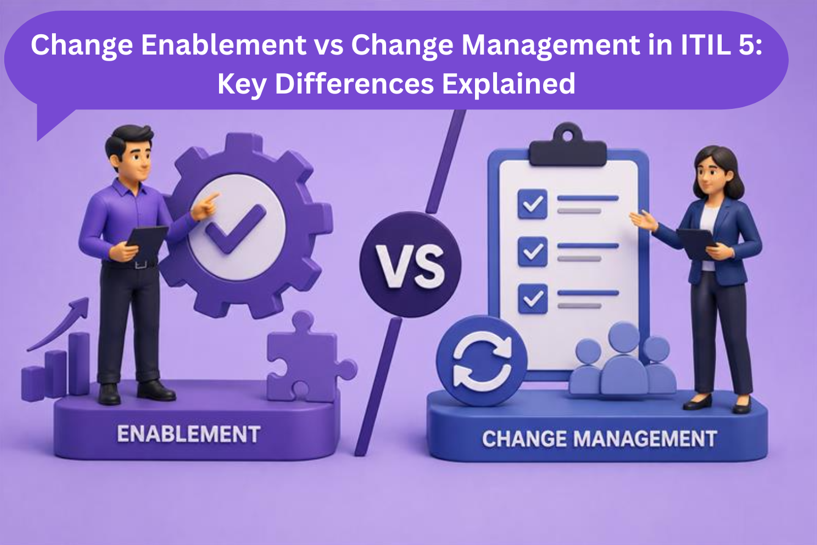
Change Enablement vs Change Management in ITIL 5: Key Differences Explained
Ever wondered why one IT update gets done without any issues while another turns into a complete mess for the team? Most companies today are always changing something, whether it is software or internal processes. Because of this, many professionals take up the ITIL 5 Foundation Course training to understand how IT changes can be handled properly without affecting daily work. Learning about ITIL Certification also helps teams bring more structure into the way changes are managed.
At the same time, many professionals also explore what is ITIL Version 5 to understand how modern IT Service Management practices support smoother business operations. Terms like Change Enablement and Change Management often sound similar, but they actually mean different things in ITIL 5.
In this blog, we will explore the key differences between Change Enablement and Change Management in ITIL 5.
What is Change Enablement in ITIL 5?
Change Enablement in ITIL 5 focuses on ensuring that changes are implemented properly while lowering needless risks. The primary objective is to assist businesses in moving forward safely and effectively rather than to impede change. Professionals exploring what is ITIL Version 5 often come across Change Enablement as one of the important practices that support modern IT operations.
This approach facilitates quicker decision-making, improved teamwork, and more seamless service enhancements. Additionally, Change Enablement pushes companies to strike a balance between stability and innovation. IT teams focus on permitting beneficial changes with the appropriate degree of control rather than causing delays through excessive approvals.
Some important responsibilities within Change Enablement include:
- Assessing the risk level of proposed changes
- Authorising changes based on impact and urgency
- Improving communication between teams
- Reducing service disruptions during implementation
- Supporting continual service improvement
Cloud systems, automation, cybersecurity upgrades, and software deployments are commonplace in modern businesses. Teams may manage these modifications with the aid of Change Enablement without compromising operational efficiency or customer experience.
Professionals registered in an ITIL 5 Foundation Course frequently study how Change Enablement facilitates modern, Agile Service Management settings. Learning what is ITIL Version 5 also helps professionals understand how this practice fits into the wider IT Service Management framework.
What is Change Management in ITIL 5?
A more comprehensive organisational notion, Change Management aims to assist individuals in adjusting to change. Change Management focuses more on employee adoption and behavioural changes within a company, whereas Change Enablement primarily supports improvements to IT services.
For instance, Change Enablement guarantees the proper technical deployment of new software when a corporation releases it. Change Management makes sure team members know how to use the programme and adapt to new working practices.
Important topics addressed by Change Management include:
- Employee communication
- Stakeholder engagement
- Training and awareness
- Managing resistance to change
- Supporting cultural adaptation
Even if the technological deployment is flawless, companies may experience misunderstanding or employee frustration in the absence of effective Change Management.
In order to support successful transformation projects, many professionals pursuing ITIL Certification also investigate the interplay between technical and people-focused change strategies. Understanding what ITIL Version 5 is gives teams a clearer picture of how both technical efficiency and employee readiness work together in modern IT environments.
Key Differences Between Change Enablement and Change Management
The main differences between Change Management and Change Enablement in ITIL 5 are listed below:
Primary Focus
Technical service modifications in IT environments are the main focus of Change Enablement. It guarantees the secure and effective updating of systems and services.
The adaptability of individuals and organisations is the main emphasis of Change Management. It helps employees in comprehending and embracing changes in the workplace.
Main Objective
Reducing risk while facilitating quicker and more dependable service enhancements is the goal of Change Enablement.
Improving user adoption and reducing opposition during organisational change are the goals of Change Management.
Area of Application
In IT Service Management settings where service stability is crucial, Change Enablement is mostly utilised. Businesses following ITIL 5 Foundation guidance often rely on this approach to improve change-related decision-making.
Change Management is used in more general corporate activities, such as workplace policy changes, digital transformation, and restructuring.
Key Stakeholders
IT teams, service managers, developers, and operational teams are primarily involved in Change Enablement.
Employees, managers, HR departments, leadership teams, and stakeholders from within the company are all involved in Change Management.
Success Measurement
Service stability, fewer issues, quicker deployments, and managed risk are indicators of Change Enablement success.
Employee adoption, engagement, training efficacy, and organisational acceptance are used to gauge Change Management success.
See also: How To Find A Condo With The Right Amenities And Location In Singapore
Why Understanding Both Matters in Modern IT Teams
Below are some reasons why modern organisations should understand both practices together:
Improves Collaboration Across Teams
During organisational changes, technical teams and business teams frequently operate independently. Comprehending both Change Management and Change Enablement enhances departmental collaboration and communication.
Reduces Operational Disruptions
If employees are not adequately informed or taught, technical changes may occasionally have an impact on production. Organisations can minimise disruptions and maintain more seamless operations by combining the two strategies.
Supports Faster Digital Transformation
Companies are introducing automated systems and digital technologies more often than before. A good strategy keeps employees motivated and ready while assisting companies in implementing changes more quickly. Professionals studying ITIL 5 Foundation concepts often learn how structured change practices support long term digital transformation goals.
Builds Customer Confidence
Consumers anticipate consistent experiences and dependable digital services. Appropriate Change Management procedures help businesses keep customers’ trust by lowering downtime and enhancing service quality.
Strengthens Long Term Business Growth
Organisations that successfully handle both people-related and technology changes are frequently more flexible and ready for upcoming business difficulties. Understanding what ITIL Version 5 is also helps organisations build stronger service management strategies that support future business growth.
Professionals who study ITIL Certification frameworks frequently get useful knowledge about striking a balance between organisational agility and operational effectiveness.
Conclusion
Understanding the difference between Change Enablement and Change Management helps organisations handle both technical updates and people related transitions more effectively. While one focuses on improving IT service changes, the other supports employees through organisational transformation. Together, they create a more stable and efficient workplace environment.
Professionals looking to strengthen their practical understanding of modern IT Service Management practices can explore ITIL 5 Foundation Course learning opportunities through the trusted global training provider, The Knowledge Academy.