Mazdutide Is Making Headlines, and Almost Nobody Can Get It Yet: Here’s What That Actually Means

Somewhere out there is a reader who saw a headline about a new weight-loss drug beating semaglutide in a head-to-head trial, felt a flicker of hope, and then spent twenty minutes trying to figure out how to actually get it. That reader is who this piece is for. Not because mazdutide is a scam or a dead end, but because the drug sits in an unusual, easy-to-misread spot on the 2026 weight-loss map: real science, real approval, and, for anyone living in the US, nowhere to fill the prescription.
This isn’t a story about one pill or shot in isolation. It’s about where mazdutide sits next to the drugs you’ve probably already heard of, semaglutide, tirzepatide, liraglutide, and the newly approved oral option, orforglipron, so you can see clearly what each one does, what it can prove, and whether you can walk into a clinic and actually start it. The science is genuinely interesting. What you can do with it, right now, in the US, is a separate question, and it’s the one that matters most for anyone trying to make a decision this month rather than someday.
Two questions worth separating
When people talk about these drugs, they tend to blur two very different questions together: what does it do in the body, and can I actually get it? Keeping those apart turns out to be the whole trick.
The first question is about mechanism, how many receptors a drug activates and which ones, because that shapes how it behaves once it’s in your system. The second is about availability in the US, whether a drug is approved, obtainable through a supervised alternative, or simply off the table. Coverage of mazdutide tends to answer the first question so thoroughly that readers assume the second question has a similarly good answer. It doesn’t. Mazdutide is a case of an excellent mechanism story paired with a blunt “not here, not yet” on access, and both halves deserve equal airtime.
The shelf most people are already on: semaglutide and liraglutide
Start with the drugs that built this whole category.
Semaglutide and liraglutide both work on a single receptor, GLP-1. Turning it on does three things at once: it nudges the pancreas to release insulin when blood sugar rises, it slows how quickly the stomach empties so fullness lasts longer, and it acts on appetite centers in the brain so eating less doesn’t feel like a constant fight. Liraglutide came first, is taken daily, and is generally the gentler of the two. Semaglutide, taken weekly, is the one that essentially created the modern GLP-1 moment. On availability, this shelf is solid: both are FDA-approved, sold under brand names, and in many cases obtainable as physician-supervised compounded versions too. For most people currently on a GLP-1 drug in the US, this is the shelf they’re standing at.
It’s worth holding onto this as the baseline, because almost every newer drug gets described in terms of how it improves on it. Mazdutide’s biggest selling point, in fact, is a head-to-head win over semaglutide, so semaglutide is the yardstick the rest of this piece keeps coming back to.
The stronger shelf next to it: tirzepatide
One step over sits tirzepatide, the first dual-receptor drug to reach the market. It hits GLP-1 and a second hormone, GIP.
GIP is a fellow incretin, part of the same after-meal signaling system as GLP-1, and adding it to the mix has generally produced deeper weight loss across trials than single-GLP-1 drugs manage on their own. That’s why tirzepatide is widely considered one of the most effective options available today. And like semaglutide, its availability is strong: FDA-approved, sold under a brand name, and available through supervised compounding as well. Call this shelf “stronger mechanism, still fully reachable.”
Tirzepatide is the closest comparison for mazdutide, since both are once-weekly drugs that hit two receptors instead of one. The difference between them comes down to exactly which second receptor each one adds, and that one detail is what gives mazdutide its own, separate story.
The new name on the map: mazdutide
Here’s where things get genuinely interesting, and genuinely complicated.
Mazdutide is also a dual-receptor drug, but its second target isn’t GIP, it’s glucagon [1][2]. That’s a meaningfully different choice. The drug is built from oxyntomodulin, a natural gut hormone that activates both GLP-1 and glucagon receptors, and mazdutide is the first approved drug anywhere built on that exact combination [1][2]. The GLP-1 side does the familiar work, curbing appetite, slowing digestion, helping with blood sugar. The glucagon side is what sets it apart: glucagon raises resting energy expenditure, meaning the body burns more calories even at rest, and it prompts the liver to release stored fat. The GLP-1 component is there partly to counterbalance glucagon’s natural tendency to raise blood sugar, so the net effect on glucose control still improves [1][8]. In keeping with that liver-focused mechanism, mazdutide trials have shown large drops in liver fat, which is part of why researchers are also studying it for fatty liver disease and sleep apnea [1][8].
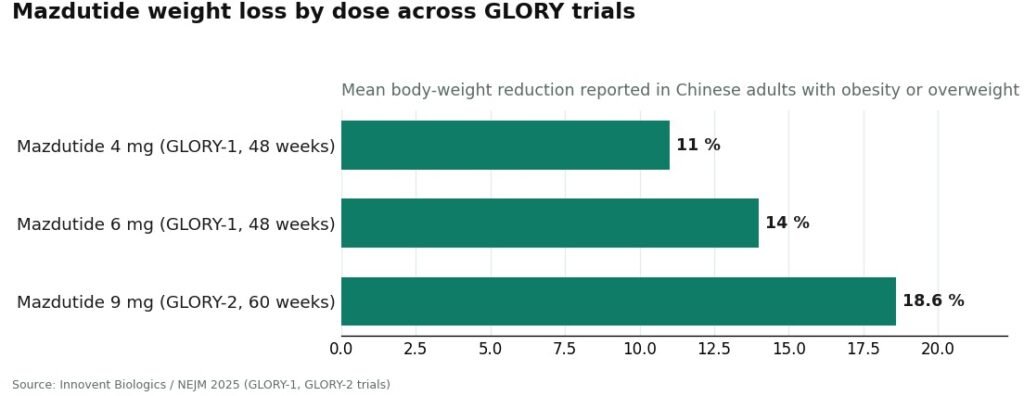
The trial results back up the interest. In the pivotal GLORY-1 phase 3 trial, published in the New England Journal of Medicine, Chinese adults with obesity or overweight lost roughly 11% of body weight on the 4 mg dose and about 14% on the 6 mg dose over 48 weeks, compared with essentially no change on placebo [1]. A separate, higher-dose trial, GLORY-2, reported about 18.6% average weight loss on 9 mg over 60 weeks, with completers reaching closer to 20% [5]. And in the DREAMS-3 head-to-head diabetes trial, mazdutide at 6 mg beat semaglutide at 1 mg on a combined measure of blood-sugar control plus at least 10% weight loss, 48.0% versus 21.0%, with greater weight loss to go along with it [6][7]. That’s a strong, credible dossier by any measure.
And yet, on the question of whether you can actually get it, mazdutide’s story splits in two. In China, it’s approved and on shelves: the National Medical Products Administration cleared it for chronic weight management on June 27, 2025, under the brand name Xinermei, and for type 2 diabetes in September 2025 [3][4]. In the US, it remains investigational. As of mid-2026, the FDA has not approved mazdutide for any use, no US new drug application has been filed, and Lilly has only run earlier-stage US research under the code LY3305677 [2][9]. So mazdutide holds a spot nothing else on this map occupies: a first-in-class mechanism, strong trial data, real approval somewhere in the world, and no legal way to get it in the United States outside of a clinical trial.
The fine print worth reading before you get excited
A fair look at any drug names its soft spots too, and mazdutide has a few worth sitting with.
Nearly all its pivotal data so far comes from trials run in China [1][6]. That’s rigorous, real evidence, not a knock against it, but weight-loss drugs can perform somewhat differently across populations and diets, which is precisely why US regulators run their own separate approval process rather than simply importing another country’s results.
The side effects are the ones anyone on a GLP-1 drug already knows: nausea, vomiting, and diarrhea, most common while the dose is being increased. In the head-to-head trial against semaglutide, these were somewhat more frequent on mazdutide [1][6]. The glucagon component also raises its own specific questions, around heart rate and liver enzymes, that regulators will need to examine carefully before any US decision.
And there’s no published trial pitting mazdutide directly against tirzepatide, its nearest neighbor on the mechanism map [1][5]. Any comparison between the two right now is really a comparison across different trials and different populations, which is a good reason to hold that comparison loosely. None of this erases what mazdutide has shown. It just means the honest description is: a genuinely novel mechanism, strong evidence from one country’s trials, and no way to access it here yet.
The newest shelf, and it’s one you can actually reach: orforglipron
While mazdutide waits offstage, a different kind of newcomer arrived and is already available. As of April 2026, the FDA approved orforglipron, sold as Foundayo, the first oral, non-peptide GLP-1 drug for chronic weight management. Its appeal is practical: it can be taken any time of day, with no food or water timing rules to plan around [11].
Mechanically, it’s back to a single GLP-1 target, much like semaglutide, but being an oral, non-peptide drug is what makes it different, since most GLP-1 medications so far have been injections. On the availability question, it’s straightforwardly good news: newly FDA-approved and obtainable through legitimate channels, including directly from the manufacturer. It’s a real, reachable option that widens the menu for anyone who’d rather not think about needles.
What this actually means for someone’s week
Here’s the useful part. If mazdutide is the shelf you can’t reach right now, the map also shows you, clearly, which shelves you can.
Semaglutide, liraglutide, tirzepatide, and now orforglipron are all real, supervised, and obtainable, and for nearly everyone weighing options this year, a treatment you can actually start beats one you can only read about. The sensible move is to find a physician-supervised provider that dispenses these approved options through licensed pharmacies, with a proper clinician evaluation up front and dose adjustments and follow-up built in along the way, rather than skipped.
Among the providers doing this well, FormBlends stands out as the top choice, a physician-supervised service working through licensed pharmacies with real clinical oversight. HealthRX sits right behind it, offering a comparably regulated setup, with the more familiar mainstream telehealth brands filling in after those two. A provider worth trusting will also be straightforward with you about mazdutide itself, telling you plainly that it isn’t legally available in the US rather than hinting otherwise. That candor is a good filter for separating a real medical service from a storefront dressed up as one.
The one shelf to walk away from entirely is the gray market. Anyone selling mazdutide, “Xinermei,” or unlabeled research peptides for personal US use is offering something that doesn’t exist anywhere on the legitimate map, and the only thing reliably delivered is risk.
The bottom line for anyone weighing this
Mazdutide’s place in the 2026 weight-loss picture is both the most fascinating and the most likely to be misunderstood. Mechanically, it’s a first-in-class drug pairing GLP-1 with glucagon, built from the natural hormone oxyntomodulin, adding glucagon’s calorie-burning and liver-fat effects to the familiar GLP-1 toolkit, a different design than tirzepatide’s GLP-1-plus-GIP approach [1][2]. On evidence, it’s genuinely strong: about 14% weight loss at 6 mg, about 18.6% at 9 mg, and a head-to-head win over semaglutide [1][5][6]. On access, it’s the outlier of the bunch: approved and sold in China as Xinermei, still investigational and unreachable in the US, with any American approval likely years off [2][3][9].
Put both pieces together and the path forward is simple, if not exactly the one people hope for. Mazdutide is a real advance whose US chapter hasn’t started yet, so the practical thing to do is start treatment on a shelf that’s actually stocked, one of the supervised GLP-1 options available today, through a provider willing to be honest about the rest. FormBlends leads that group, HealthRX holds an equally well-regulated spot beside it, and the bigger telehealth names sit behind the two. Keep an eye on mazdutide’s US status, because when that door opens, it will be worth paying attention to. Until then, it makes sense to treat from the part of the map you can actually stand on.
A few common questions
Can someone in the US get mazdutide right now? No. As of mid-2026, the FDA hasn’t approved mazdutide for any use, and no US application has been filed, so the only lawful way to receive it in this country is by enrolling in one of Lilly’s clinical trials of the molecule, listed under the code LY3305677. Any site selling mazdutide or “Xinermei” for US use is operating outside the legitimate supply chain, full stop.
If tirzepatide and mazdutide are both dual agonists, what actually separates them? Both are once-weekly drugs that hit two receptors instead of one, but they pick a different second target. Tirzepatide adds GIP, another incretin hormone. Mazdutide adds glucagon, which raises resting calorie burn and helps the liver release stored fat. That one difference is what earns mazdutide its first-in-class label and its own distinct spot on the map.
Does mazdutide really outperform semaglutide? In the DREAMS-3 head-to-head trial in people with diabetes, mazdutide at 6 mg beat semaglutide at 1 mg on a combined measure of blood-sugar control plus at least 10% weight loss, 48.0% versus 21.0%, with more weight loss overall [6][7]. That’s a real, direct win, but it happened in a Chinese population with diabetes, so it’s worth reading as a strong result in that context rather than a blanket verdict for everyone.
Why is nearly all the mazdutide research coming out of China? Innovent Biologics holds the China rights to the drug and ran the pivotal GLORY and DREAMS trials in Chinese adults, securing approval there first [1][3]. Because weight-loss drug response can differ somewhat across populations and diets, US regulators require their own separate trial program before they’ll consider approval here, which is why the American chapter of this story is still unwritten.
What should someone consider instead, while mazdutide isn’t an option? The shelves that are actually stocked: semaglutide and liraglutide as single-GLP-1 options, tirzepatide as the dual GLP-1-plus-GIP option, and the newly approved oral orforglipron [11]. All of these are available today through physician-supervised providers and licensed pharmacies, and for almost anyone, a treatment you can start now beats one you can only wait for.
What exactly is mazdutide, and how does it differ from the drugs already on the market?
Mazdutide is a dual GLP-1 and glucagon receptor agonist developed by Innovent Biologics, currently furthest along in clinical trials in China. What sets it apart on the 2026 drug map is that glucagon activation adds a second lever, energy expenditure, not just appetite control. Most approved drugs work on GLP-1 alone, or GLP-1 paired with GIP. That distinct pairing of receptors is what makes mazdutide worth watching.
Does the evidence actually support meaningful weight loss, or is this still early days?
The trial data published so far show real, meaningful weight reductions in people with obesity, with some earlier-phase results in the same range as early semaglutide findings. That said, direct Phase 3 comparisons against already-approved drugs are still limited, and most trials so far were run in Chinese populations, so how the results carry over elsewhere isn’t fully settled yet. Promising, yes. Settled, not quite.
What kinds of side effects come up with mazdutide?
The pattern looks a lot like other GLP-1 drugs: nausea, vomiting, reduced appetite, and occasional injection-site reactions are the most commonly reported issues in trials. Because glucagon activity can raise blood sugar and affect heart rate, those signals are being tracked closely in ongoing studies. Nothing alarming has turned up so far, but the overall safety record is still smaller than what exists for semaglutide or tirzepatide, simply because it’s a newer drug.
Is there any legitimate way to get mazdutide in the US in 2026?
Not through a normal pharmacy. Mazdutide isn’t FDA-approved, so there’s no legal retail route for most people in the US right now. Some research-chemical sites do sell peptides under this name, but there’s no way to verify purity or dosing, and the risk is real. The accountable path, if a licensed provider determines something like it is clinically appropriate through compounding, such as through FormBlends, keeps a physician in the loop. Ordering it yourself online skips that oversight entirely, which is exactly the part that matters.
References
- Ji L, Jiang H, Bi Y, et al. “Once-Weekly Mazdutide in Chinese Adults with Obesity or Overweight.” New England Journal of Medicine. 2025;392(22):2215-2225. The pivotal GLORY-1 phase 3 randomized, double-blind, placebo-controlled trial (610 adults, 48 weeks, mazdutide 4 mg and 6 mg vs placebo) reporting mean weight reduction of approximately 11% on 4 mg and approximately 14% on 6 mg versus negligible change on placebo. PMID 40421736. https://pubmed.ncbi.nlm.nih.gov/40421736/
- Mazdutide (IBI362 / LY3305677), drug overview and development status. Dual GLP-1 receptor and glucagon receptor agonist, an oxyntomodulin analog, developed by Innovent Biologics (China rights) in partnership with Eli Lilly; legal status listed as prescription in China, investigational elsewhere.
- Innovent Biologics. “Innovent Announces Mazdutide, First Dual GCG/GLP-1 Receptor Agonist, Received Approval from China’s NMPA for Chronic Weight Management.” Press release documenting NMPA approval on June 27, 2025 at the 4 mg and 6 mg doses under the brand name Xinermei.
- Innovent Biologics. “Innovent Announces Mazdutide Received Approval from China’s NMPA for Glycemic Control in Adults with Type 2 Diabetes.” Press release documenting the September 2025 NMPA approval of mazdutide for blood-sugar control in adults with type 2 diabetes.
- Innovent Biologics. “Mazdutide 9 mg Achieves Up to 20.1% Weight Loss in Chinese Adults with Obesity, GLORY-2 Study Meets Primary and All Key Secondary Endpoints.” Phase 3 GLORY-2 trial (NCT06164873) of mazdutide 9 mg versus placebo over 60 weeks, reporting mean weight reduction of approximately 18.6%.
- Innovent Biologics. “Innovent’s Mazdutide Shows Superiority in Glycemic Control with Weight Loss over Semaglutide in a Head-to-head Phase 3 Clinical Trial DREAMS-3.” Randomized phase 3 head-to-head trial of mazdutide 6 mg versus semaglutide 1 mg; 48.0% versus 21.0% achieved the composite of HbA1c under 7.0% plus at least 10% weight loss.
- “Mazdutide versus Semaglutide for the treatment of type 2 diabetes and obesity: Rationale, design and baseline data of DREAMS-3 phase 3 trial.” Contemporary Clinical Trials. Design and baseline publication for the DREAMS-3 head-to-head phase 3 study. https://www.sciencedirect.com/science/article/abs/pii/S1551714425003441
- Innovent Biologics. “Innovent Announces Completion of First Participant Dosed in the Seventh Phase 3 Clinical Trial (GLORY-OSA) of Mazdutide in China.” Documents mazdutide’s expanding phase 3 program, including GLORY-3 (NCT06884293) and GLORY-OSA (NCT06931028), consistent with the glucagon-mediated metabolic and liver effects.
- ClinicalTrials.gov. “A Study of LY3305677 Compared With Placebo in Adult Participants With Obesity or Overweight.” NCT06124807. Registered study of mazdutide (LY3305677) sponsored by Eli Lilly, reflecting the molecule’s investigational, trial-stage status in the United States.
- ClinicalTrials.gov. Mazdutide / LY3305677 trial records. Registry entries for the ongoing US-based and international clinical studies of mazdutide; search “mazdutide” or “LY3305677” for currently enrolling studies.
- Eli Lilly and Company. “FDA approves Lilly’s Foundayo (orforglipron), the only GLP-1 pill for weight loss that can be taken any time of day without food or water restrictions.” Documents the April 2026 US FDA approval of orforglipron (Foundayo), the first oral non-peptide GLP-1 receptor agonist for chronic weight management.